Pride and the Practice of Love
Jun 03, 2026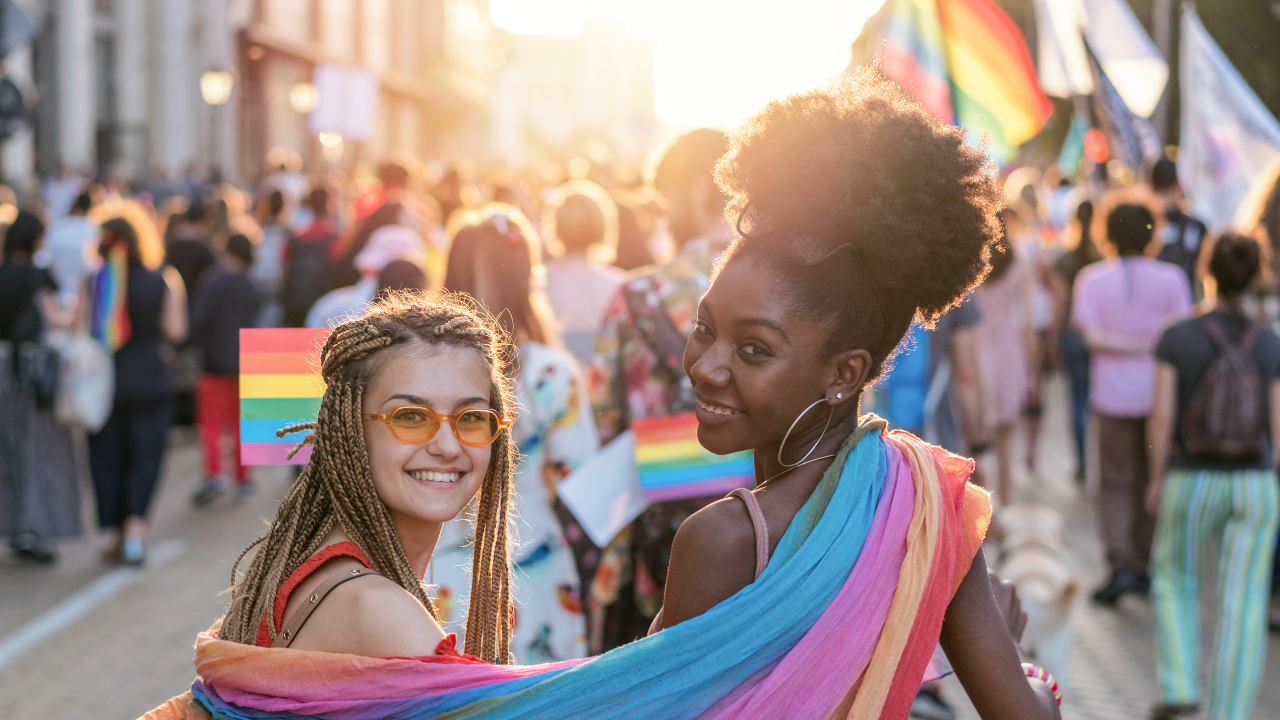
The last couple of years I have written about Pride month on socials and been unpleasantly surprised by the amount of prejudice, hate even, on a yoga page. So this year I just wanted to state once more for the record that yoga is plain and simple a practice of love and acceptance.
The foundational principle according to the Patanjali sutras is ahimsa, usually translated as the non-harming of others. This requires that we see others clearly, without the distortion of our own fear or conditioning.
The second foundational principle is truth. Not the truth of a "God" who sits in judgement. Because as soon as we see everything through judgement our view is clouded. It is clouded by prejudice.
To live in truth, or God's truth if that's how you perceive, your view surely has to be clouded with love. Because God is love, right? Isn't that what everyone says?
So as yoga teachers we work towards a deep and radical acceptance. It is work because our life's conditioning will have shaped the way we look at things. It is inbuilt to our nervous systems. So it takes self study, svadhyaya, another of the foundations of Patanjali yoga, to explore what is really true.
In fact the whole path of yoga is really a deep dive into what is the ultimate truth. What is true beyond the changing states of nature. What is true beyond the division into opposites.
Any hate, however we justify it, is just that. Hate. And as we have all seen in these last hideous years of wars and genocide, hate never ends well.
I grew up in 1970s London in a confusing blend of Catholicism and bohemian openness, and what I absorbed from that collision was just how confusing the world is when we try to hold onto a moral code written by men, and overwhelmingly by white men, asserting what is acceptable and what is not. It is terrifying, and that judgement affects all of us because no one can thrive living in fear of being judged.
Who knows this better than those who grow up knowing they do not fit the mould, those who are bullied or beaten for simply being themselves, or rejected outright from their communities? To have to ask for acceptance in order to exist as yourself is something no person should ever have to do.
What's happening today
In the UK, over 18,000 hate crimes motivated by sexual orientation and more than 3,000 trans-related hate crimes were recorded in a single year, with those numbers having risen 20% and 50% respectively over the past five years. We see as with racism and racist violence, that a more radical, nationistic, right wing politics also means more hate crime.
In the US, LGBTQ+ people are nine times more likely to experience violent hate crimes than non-LGBTQ+ people. And 91% of people who experience anti-LGBT+ hate crime never report it, so every number you read is only a fraction of what is actually being lived. Stonewall + 2
What is the fear
So what is the fear? What is it that makes us judge another person's love, another person's way of being in the world? Because underneath judgement there is always fear, and fear always contracts, always diminishes, always causes harm.
Yoga guides us in the opposite direction. Over time as we settle into body and breath awareness, as we examine the thoughts that randomly pop up in our minds and see that our judgements are not based in truth, as we return to the practice of loving kindness and realise every person is worthy of the same love and respect, we feel that there is a deep love possible, that we never were separate or alone. We know ourselves to be held, accepted, loved exactly as we are. And from that place it becomes not just possible but natural to celebrate every single person exactly as they are.
Inclusive Yoga Training
A step by step guide to creating classes that share asana in an inclusive way with philosophy themes woven through that focus on wholeness and acceptance.
Read more here.
A quick note on what I refer to as the foundations -
Yamas & Niyamas of the Patanjali Yoga Sutras
For those who are not familiar with the yoga tradition beyond the physical practice, a little context. In the blog above I refer to the foundations of yoga as drawn from the Yoga Sutras of Patanjali, the first systematic written recording of yoga philosophy, compiled somewhere around 400 CE. What Patanjali gave us is remarkable: a complete philosophy and practice, a step by step guide to liberation that is as radical and relevant today as it was when it was written. Eight limbs, each one building on the last, taking us from how we treat others all the way to the deepest states of consciousness. Be amazed by that.
The first two limbs are the yamas and niyamas, ten ethical and personal principles that form the foundation of everything that follows.
The yamas govern how we relate to the world around us:
- Ahimsa, non-harming
- Satya, truthfulness
- Asteya, non-stealing
- Brahmacharya, right use of energy
- Aparigraha, non-grasping
The niyamas turn that same attention inward:
- Saucha, cleanliness and purity
- Santosha, contentment
- Tapas, discipline
- Svadhyaya, self-study
- Ishvara pranidhana, surrender to something greater than ourselves
From there the path moves through asana (the postures), pranayama (breath practices), pratyahara (withdrawal of the senses), dharana (concentration), dhyana (meditation), and finally samadhi, a state of complete absorption and unity. A full map of what it means to be human, and what we are capable of when we stop contracting around fear and start opening toward love.
Like what you've read?
Sign up to my newsletters and I'll share new articles with you. Plus you'll be the first to hear about my upcoming classes, courses, workshops and offers, and you'll receive my free bandhas video in your welcome email.
I respect your privacy. I won’t bombard you, and I won’t share your details. View my privacy policy for more information.